
Wrong-way crashes are among the most frightening collisions that can occur on American highways. A driver enters an exit ramp, travels against traffic, and suddenly places motorists moving legally in the opposite direction in the path of a potentially devastating head-on collision. Because these crashes frequently occur on freeways and divided highways, there may be little time for an approaching motorist to recognize the danger or escape it.
The Federal Highway Administration defines a wrong-way driving crash as one involving a vehicle traveling opposite the legal flow of traffic on a high-speed divided highway or access ramp and colliding with a vehicle traveling correctly. FHWA reports that 704 people died in wrong-way-driving crashes in the United States in 2022, up from 445 in 2018.
After one of these accidents, attention naturally turns to the driver traveling the wrong way. In many cases, that driver may bear substantial responsibility. However, determining wrong-way driving accident liability does not always end with the person behind the wheel.
Depending on the circumstances and the law of the state where the collision occurred, an investigation may also examine an employer, vehicle owner, alcohol-serving establishment, manufacturer, contractor, or government agency responsible for the roadway. Identifying every potentially responsible party can be especially important when a collision causes catastrophic injuries, multiple deaths, or losses that exceed an individual driver’s insurance coverage.
Why Wrong-Way Driving Accidents Are So Dangerous
Most vehicles traveling on a divided highway move in the same direction. That design substantially reduces the likelihood of head-on impacts. Wrong-way driving defeats that basic safety feature by placing vehicles traveling in opposite directions directly in one another’s paths.
According to the Federal Highway Administration, wrong-way crashes typically involve high-speed head-on or opposite-direction sideswipe impacts and tend to be more severe than many other types of collisions.
The combined forces involved can be enormous. A properly traveling motorist may have only seconds to react after noticing headlights approaching from the wrong direction. At night, the driver may initially assume those headlights belong to traffic on the other side of the highway or another nearby roadway.
Victims can suffer traumatic brain injuries, spinal cord damage, fractures, internal injuries, chest trauma, burns, permanent disabilities, and fatal injuries. AccidentLawFirm.org’s guide to common injuries after high-speed highway collisions explains why crashes occurring at interstate speeds can create particularly serious medical consequences.
The Wrong-Way Driver Is Usually the Starting Point
An investigation normally begins by determining why the vehicle entered the roadway incorrectly. Drivers have a legal obligation to follow traffic-control devices, remain on the proper side of the roadway, and operate their vehicles with reasonable care.
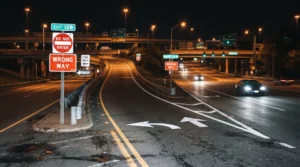
A wrong-way driver may have ignored a Do Not Enter sign, turned onto the wrong ramp, crossed a median, become confused at an interchange, or continued driving after recognizing a mistake. Investigators may also consider whether alcohol, drugs, distraction, fatigue, poor vision, unfamiliarity with the area, or another factor contributed to the driver’s actions.
Evidence may include police reports, witness statements, dashcam video, surveillance footage, toxicology results, vehicle event data, cell-phone records, GPS information, roadway photographs, and electronic data collected by the vehicle.
Even when the driver’s error appears obvious, however, a complete liability analysis should consider what happened before the vehicle entered the wrong side of the highway. That broader investigation can reveal whether another person, business, or entity contributed to the circumstances that produced the crash.
Can the Wrong-Way Driver’s Employer Be Liable?
Employer liability can become an important issue when the wrong-way vehicle was being operated for work. Examples may include delivery drivers, sales representatives, commercial truck drivers, utility employees, contractors, shuttle operators, and employees traveling between job locations.
Under legal principles commonly known as respondeat superior or vicarious liability, an employer may sometimes be responsible for negligent conduct committed by an employee while acting within the scope of employment. The precise rules differ from state to state, so the driver’s employment status and activities at the time of the crash become important.
Investigators may ask whether the driver was making deliveries, traveling to a work assignment, transporting customers, operating a company vehicle, or performing another task benefiting the employer.
An employer could also face claims based on its own conduct rather than simply its relationship with the driver. Depending on applicable state law and the evidence, questions may arise about negligent hiring, training, supervision, or retention.
For example, an investigation might examine whether a commercial driver had a history of unsafe driving that should have raised concerns, whether appropriate training was provided, or whether an employer knowingly permitted an unqualified person to operate a vehicle.
A Vehicle Owner May Be a Separate Defendant
The person driving the wrong-way vehicle is not necessarily the person who owns it. The vehicle could belong to a family member, business, rental company, leasing company, or another individual.
Whether an owner can be held responsible varies considerably among states and depends on the relationship between the owner and driver. Some states recognize forms of owner liability or negligent entrustment under particular circumstances.
Negligent entrustment generally focuses on whether a vehicle owner knowingly allowed someone who was incompetent or unfit to drive the vehicle. Relevant evidence could include a driver’s license status, previous crashes, repeated traffic violations, intoxication, known medical limitations, or other facts suggesting that permitting that person to drive created an unreasonable risk.
Ownership alone does not automatically establish liability everywhere in the United States. The applicable state’s statutes and case law must be evaluated before determining whether the owner can be included in a claim.
Alcohol-Serving Businesses May Be Investigated
Alcohol impairment has long been associated with serious traffic crashes. The Insurance Institute for Highway Safety explains that alcohol can impair judgment, vision, coordination, and reaction time and that crash risk rises as a driver’s blood alcohol concentration increases.
When a wrong-way collision involves an intoxicated driver, investigators may attempt to determine where the driver obtained alcohol before the crash. That can lead to questions about bars, restaurants, nightclubs, event venues, or other establishments.
However, liability for businesses serving alcohol is highly state-specific. Many states have statutes commonly called dram shop laws, but the circumstances required to establish a claim differ substantially. Some jurisdictions allow claims when alcohol is served to a visibly intoxicated person. Others impose narrower standards, additional requirements, or significant limitations.
For that reason, it is inaccurate to assume that a restaurant or bar is automatically responsible merely because an intoxicated customer later causes a collision.
Potential evidence can include receipts, credit-card records, surveillance footage, witness testimony, employee statements, alcohol purchases, toxicology evidence, and the timeline between the driver’s final drink and the crash.
For additional information about alcohol and crash risk, the Insurance Institute for Highway Safety provides national research on alcohol-impaired driving.
Road Design Can Become Part of the Investigation
Wrong-way crashes often begin at freeway entrances, exits, or intersections connecting local streets with divided highways. If a motorist enters the wrong ramp, investigators may examine more than the driver’s actions. They may also inspect the road itself.
Questions can include whether Do Not Enter and Wrong Way signs were present, correctly positioned, visible, adequately maintained, and consistent with applicable traffic-engineering standards. Investigators may also evaluate pavement arrows, lane markings, lighting, ramp geometry, sight distance, construction configurations, vegetation, and other roadway characteristics.
FHWA identifies wrong-way driving as a highway safety concern and discusses countermeasures that transportation agencies may consider at interchanges. These can include improvements to signs, markings, lighting, channelization, and other features intended to help motorists recognize that they are entering a roadway incorrectly.
Roadway conditions become particularly significant when the same interchange has experienced repeated wrong-way entries or when previous complaints, crashes, safety studies, or engineering reviews identified a potential problem.
Can a Government Agency Be Held Responsible?
Many highways, ramps, signs, and traffic-control systems are owned or maintained by federal, state, county, or municipal government entities. If a hazardous roadway condition contributed to a wrong-way crash, an injured person may investigate whether the responsible public agency can be held liable.
These cases are considerably more complicated than ordinary claims against private motorists.
Government entities often receive special protections under state law, including various forms of governmental or sovereign immunity. Some jurisdictions recognize exceptions that permit claims involving dangerous roadway conditions, negligent maintenance, or other circumstances, while other protections may apply to engineering and design decisions.
Claims against public entities can also involve special notice requirements and deadlines that are much shorter than the ordinary statute of limitations for a personal injury lawsuit.
As a result, evidence about road ownership, maintenance responsibility, prior crashes, safety complaints, repair records, engineering studies, and traffic-control plans may need to be obtained quickly.
A claim should never assume that a transportation department is liable merely because a crash occurred on a public highway. Liability depends on the applicable state’s law and evidence showing that a legally actionable roadway condition contributed to the collision.
Road Contractors May Also Share Responsibility
Not every dangerous roadway condition is created directly by a government transportation agency. Highway construction and maintenance are frequently performed by private contractors and subcontractors.
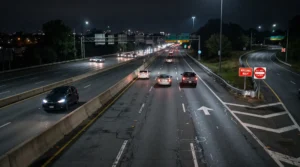
Temporary traffic-control arrangements can substantially alter familiar routes. Lanes may be shifted, ramps temporarily relocated, markings covered, signs moved, or traffic redirected through construction zones.
If a wrong-way driver became confused because temporary traffic controls were improperly installed or maintained, investigators may examine the contractors responsible for the work.
Potential evidence can include construction plans, traffic-control plans, inspection records, work logs, contracts, photographs, prior complaints, and records showing when signs or pavement markings were installed or changed.
Responsibility may ultimately depend on who controlled the area and who had the contractual or legal duty to maintain specific traffic-control devices.
Could a Defective Vehicle Cause or Worsen the Accident?
Some wrong-way crashes may also raise product-liability questions. A vehicle defect generally does not explain why a motorist drove onto an exit ramp in the wrong direction, but a mechanical or electronic failure can sometimes contribute to a crash or increase its severity.
Investigators may examine steering systems, brakes, headlights, tires, electronic stability systems, driver-assistance features, or other components if there is evidence that they failed.
Modern vehicles also collect extensive electronic information. Depending on the model, investigators may recover data relating to speed, braking, steering inputs, seat-belt use, and other vehicle functions immediately before impact.
A manufacturer, component supplier, or other company could potentially become involved if evidence indicates that a defective product contributed to the collision or injuries. Product-liability laws vary by state, and proof normally requires much more than the fact that a component was damaged during the crash.
Commercial Vehicles Can Add Multiple Layers of Liability
A wrong-way crash involving a tractor-trailer, delivery truck, bus, or other commercial vehicle can involve additional parties and evidence.
Besides the driver, investigators may look at a motor carrier, employer, vehicle owner, maintenance contractor, freight company, or another business involved in the operation. Commercial vehicles may also generate electronic logging information, telematics records, dispatch communications, GPS histories, maintenance documents, and inspection records.
If driver fatigue contributed to confusion or an incorrect freeway entry, hours-of-service information can become relevant. If a mechanical problem contributed, inspection and maintenance records may help identify how and when the problem developed.
The presence of multiple companies does not mean that every company is legally responsible. It does mean that determining who controlled the driver and vehicle can require a more detailed investigation than a typical two-car accident.
Comparative Fault Can Affect Recovery
Wrong-way crashes can appear straightforward, particularly when one vehicle was clearly traveling against traffic. Nevertheless, insurers and defendants may still dispute how responsibility should be divided.
Most states use some form of comparative fault, while a smaller number continue to apply contributory negligence rules. The specific system can have a major effect on whether an injured person can recover compensation and whether that compensation is reduced because of his or her own conduct.
An insurer might argue that the properly traveling driver was speeding, distracted, impaired, or failed to react reasonably after seeing the approaching vehicle. Whether such an argument has merit depends entirely on the evidence.
Multiple defendants may also attempt to blame one another. A wrong-way driver could argue that confusing ramp design contributed to the mistake. A government agency might argue that the signs complied with required standards. A contractor might contend that another company controlled the relevant work area.
Accident reconstruction and preservation of objective evidence can therefore become critical when responsibility is contested.
Evidence Can Reveal Liability Beyond the Driver
A broader wrong-way accident investigation often requires evidence that is not immediately visible at the crash scene.
Police photographs and reports can establish the location of the vehicles and identify witnesses. Dashcams may show when the wrong-way vehicle entered the roadway. Traffic cameras can reveal the driver’s route before impact. Event data recorders may provide information about speed and braking.
Cell-phone and GPS information may help reconstruct the driver’s movements. Toxicology evidence can show whether alcohol or drugs were involved. Employment records can establish whether the driver was working. Receipts and surveillance recordings may identify where alcohol was purchased. Engineering documents can reveal previous safety concerns at the ramp.
The location itself should also be documented. Signs, lane markings, lighting, construction barriers, vegetation, and temporary traffic controls can change after a collision. Photographs and video taken close to the time of the crash may therefore become particularly valuable.
Why Prior Wrong-Way Incidents at the Same Location Matter
A single driver’s mistake may provide little evidence that a ramp or interchange is unusually confusing. A history of similar wrong-way entries can present a different picture.
Prior police reports, emergency dispatch calls, transportation-agency records, complaints from motorists, engineering studies, and documented near misses may reveal that transportation officials were aware of recurring problems.
That does not automatically establish legal liability. However, prior incidents can help investigators determine whether a location had an identifiable pattern and whether additional safety measures were previously considered or implemented.
FHWA encourages transportation agencies to evaluate wrong-way-driving risks and potential countermeasures. Its resources discuss approaches ranging from conventional signs and pavement markings to more targeted treatments at problematic locations.
The FHWA Proven Safety Countermeasures program also provides transportation agencies with evidence-based strategies intended to reduce serious injuries and fatalities on American roads.
Who Pays When Several Parties Are Responsible?
When several parties contribute to the same crash, determining financial responsibility depends on the law of the state where the claim is brought.
An injured motorist might potentially have claims involving the wrong-way driver’s automobile insurance, an employer’s commercial policy, a vehicle owner’s coverage, or another defendant’s liability insurance. If available liability coverage is insufficient, uninsured or underinsured motorist coverage may also become relevant depending on the injured person’s policy and state law.
Claims involving severe brain injuries, spinal cord damage, amputations, permanent disability, or wrongful death can create losses far greater than the minimum automobile liability insurance carried by many drivers. Identifying other legally responsible parties is therefore not simply an academic issue. It can affect whether sufficient insurance or assets exist to address the full extent of a victim’s losses.
Damages After a Wrong-Way Driving Accident
Compensation available in a personal injury claim depends on applicable law and the specific harm caused by the collision.
Economic losses may include emergency treatment, hospitalization, surgery, rehabilitation, medication, future medical care, lost income, reduced earning capacity, property damage, and other documented expenses.
Depending on state law, injured people may also pursue non-economic damages for consequences such as physical pain, emotional distress, disability, disfigurement, and loss of enjoyment of life.
Fatal wrong-way crashes may give surviving family members potential wrongful-death claims. The individuals permitted to bring such claims and the damages available vary by jurisdiction.
Because serious wrong-way collisions can produce lifelong consequences, evaluating future losses may require medical specialists, rehabilitation professionals, vocational experts, economists, and other professionals.
What to Do After a Wrong-Way Highway Crash
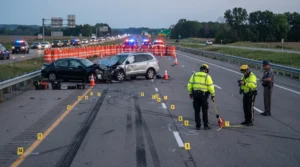
The immediate priority following any serious collision is safety and medical care. Call 911 when possible and move away from active traffic only if it can be done safely. High-speed highway crash scenes can remain dangerous because approaching motorists may encounter stopped vehicles, debris, emergency responders, or damaged barriers.
Anyone experiencing pain, confusion, dizziness, weakness, breathing difficulty, or other symptoms should seek prompt medical attention. Some serious injuries are not immediately obvious after a violent impact.
When circumstances permit, preserving evidence can also help. Photographs of the vehicles, ramp entrance, signs, pavement markings, construction conditions, and surrounding roadway may later clarify how the wrong-way entry occurred.
Witness contact information can be valuable because independent motorists may have seen the vehicle enter the highway or observed its behavior before the collision.
Insurance companies should be notified as required, but injured people should be cautious about making assumptions regarding fault or the full extent of their injuries before the investigation and medical evaluation are complete.
Wrong-Way Accidents Require a Broader Liability Investigation
A motorist traveling against traffic is often the most obvious person responsible for a wrong-way collision, but the legal analysis should not necessarily stop there.
The driver’s employer may have been directing the trip. An owner may have entrusted a vehicle to an unsafe driver. Alcohol service could become relevant under a state’s dram shop law. A construction contractor may have created confusing temporary traffic controls. A transportation agency may have responsibility for a hazardous roadway condition. A defective vehicle component could have contributed to the crash or worsened the injuries.
None of these parties is automatically liable. Each potential claim requires evidence connecting that party’s conduct or legal responsibility to the collision.
That is why preserving records, electronic vehicle data, surveillance video, roadway evidence, employment information, engineering documents, and other evidence can be so important after a catastrophic wrong-way crash.
Wrong-way-driving accidents are comparatively uncommon, but when they occur, their consequences can be devastating. Understanding every factor that contributed to the collision can help victims and families determine who may be legally responsible and what sources of compensation may be available under the laws of the state where the accident occurred.